
Introduction: Why Understanding Whitetail Behavior Changes Everything
Hunting white-tailed deer isn’t about outshooting a dumb animal — it’s about outthinking one of North America’s most adaptable and intelligent game animals. Over 30+ years in the field, I’ve learned that successful deer hunting comes down to one simple principle: understand the deer, and the deer will guide you to success.
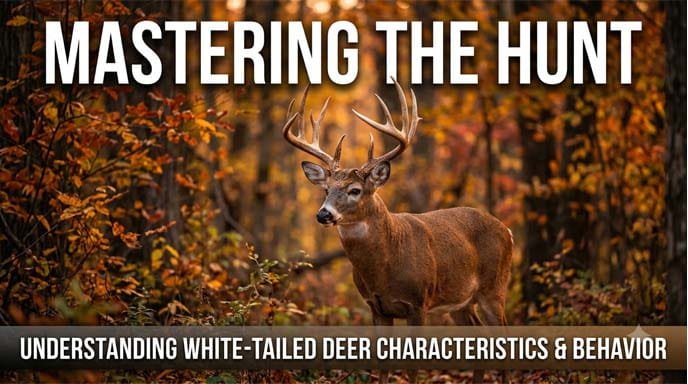
White-tailed deer (Odocoileus virginianus) have survived and thrived for over 40 million years through extraordinary sensory abilities, complex behavioral patterns, and an almost supernatural wariness that has made them the most challenging and rewarding target for hunters across North America. In recent decades, their population has rebounded from ~350,000 in the early 1900s to over 30+ million today — a testament to their resilience and adaptability.
This guide pulls together decades of field observation, research, and hunting experience to reveal how whitetails think, move, communicate, and survive. More importantly, it shows you how to apply that knowledge in the field to become a more effective, ethical, and successful hunter.
Physical Characteristics: What You’re Dealing With
Size, Weight & Build
White-tailed deer are medium-sized ungulates with significant regional variation in body size. Northern whitetails tend to be larger than southern populations due to a phenomenon called Bergmann’s Rule (animals in colder climates grow larger for better heat retention).
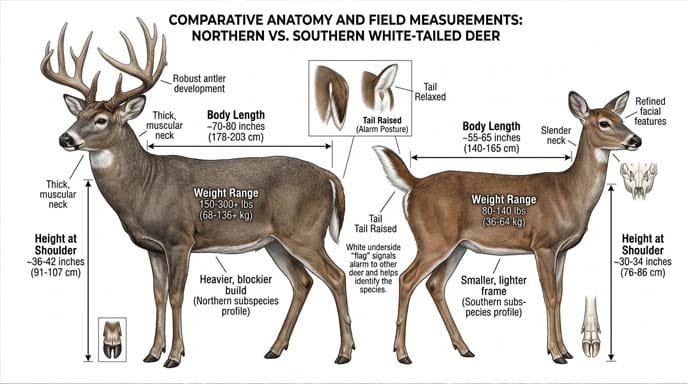
⚙ Typical Measurements:
Does (females): 90-200 lbs, 3-3.5 feet tall at shoulder
Bucks (males): 100-300+ lbs, 3.5-4+ feet tall at shoulder
Large northern bucks: Can exceed 400 lbs (rare, exceptional)
Body length: 4-7 feet nose to tail base
Tail: 6-11 inches (raised when alarmed — the famous white flag)
Coloration & Camouflage
Whitetail coat color changes seasonally. In summer, they wear a reddish-brown (chestnut) coat. By fall/winter, this shifts to a darker grayish-brown that provides excellent camouflage in dormant hardwood forests. The white underside of the tail, which gives the species its name, serves as a danger signal — when raised, it flags subordinate deer to follow the fleeing doe’s white target.
Antlers & Rack Development
Only male deer grow antlers. Antler growth is driven by testosterone and photoperiod (day length). Most bucks shed antlers in late winter (January-March) and begin regrowing them in spring. Antler growth reaches peak size during the summer rut (July-August) when testosterone peaks, then hardens in September.
Antler growth timeline:
- March-April: Antler growth begins (soft velvet stage)
- July-August: Antlers fully grown, velvet begins shedding
- September: Velvet completely shed, antlers hard and ready for rut
- December-January: Peak rut activity, antlers used in sparring/fighting
- January-March: Antlers drop (cast) as testosterone drops post-rut
Sensory Abilities: The Whitetail’s Weapons Against Predators
A whitetail’s survival depends on detecting danger before the danger detects them. Their senses are finely tuned survival instruments. Understanding these senses — and how to defeat them — is the foundation of successful hunting.
1. Sense of Smell (Primary Threat Detection)
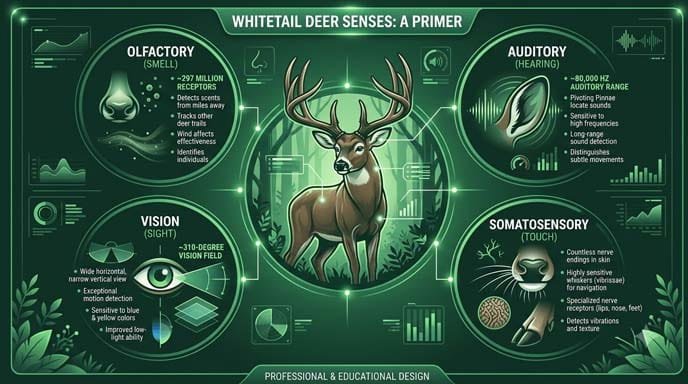
Smell is a whitetail’s most powerful sense and their primary defense mechanism. They have approximately 297 million olfactory receptors compared to a human’s 5-6 million. A whitetail’s nose is not just sensitive — it’s strategically sophisticated.
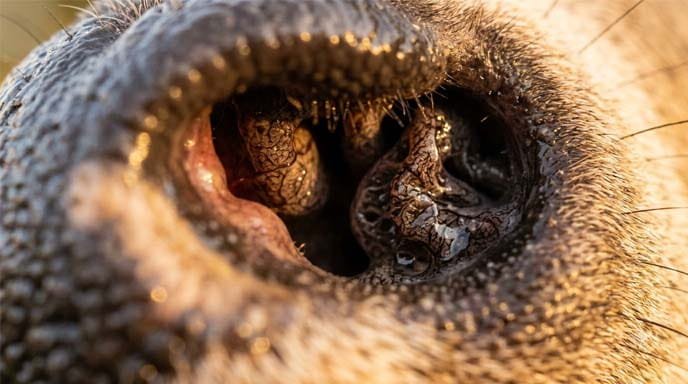
How Whitetail Smell Works:
Vomeronasal organ (Jacobson’s organ): This specialized sensory organ in the roof of the mouth detects pheromones and chemical compounds at concentrations imperceptible to standard olfaction. Does use this to detect rut pheromones from bucks; bucks use it to pinpoint does in heat.
Wind awareness: Whitetails constantly monitor wind direction and will position themselves upwind of potential threats. A whitetail will often circle downwind of you to confirm your scent before approaching or fleeing.
Scent discrimination: A whitetail can distinguish between individual deer, predators, and humans by scent alone — they can even tell the difference between a doe in heat and one that isn’t.
Scent detection ranges (optimal conditions):
- Human odor: 500-1000+ yards
- Fresh human footfall: 300+ yards
- Human sweat/urine: Can be detected from over 1 mile away in certain conditions
- Rut pheromones (doe in heat): Up to 2-3 miles (especially for bucks)
2. Vision (Motion Detection & Spatial Awareness)
Whitetails don’t see the world the way humans do. Their eyes are positioned on the sides of their head, providing a field of view of nearly 310 degrees — they can see behind themselves without turning their head. Their vision is exquisitely tuned to detect motion.
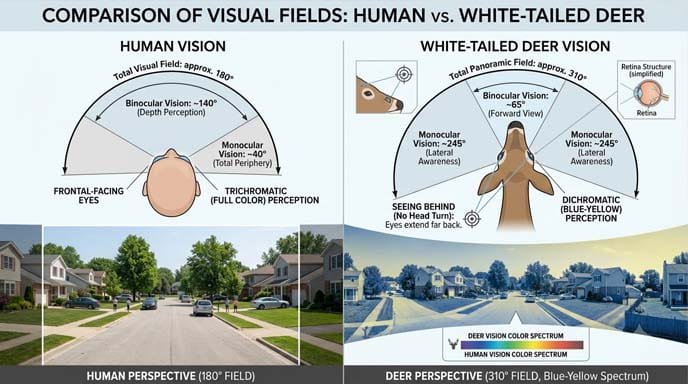
Whitetail Vision Characteristics:
Field of view: ~310 degrees (humans: ~180 degrees)
Blind spots: Small area directly behind rear and small area in front of nose
Motion detection: Exceptional — a whitetail can detect movement from incredible distances
Low-light vision: Superior to humans; more effective at dawn/dusk
Color vision: Blue-yellow spectrum (red appears dark/black)
Visual acuity: Roughly equivalent to humans at identifying stationary objects, but vastly superior at detecting movement
3. Hearing (Directional Threat Assessment)
Whitetail ears are large, funnel-shaped, and highly mobile. They can rotate independently up to 180 degrees, allowing them to pinpoint sound sources with precision. A whitetail’s hearing is approximately as sensitive as a human’s, but their ability to directionally locate sound is superior.
- Can hear frequencies up to 80,000 Hz (human upper limit ~20,000 Hz)
- Can distinguish between natural and unnatural sounds with remarkable accuracy
- A snapping twig is instantly identified as potentially threatening
- Can pinpoint a sound source within a few degrees of accuracy
- Alerted whitetails often stand motionless, ears pinned toward the sound, assessing threat level
Behavioral Traits: How Whitetails Think & React
Flight Response & Threat Assessment
A common misconception is that whitetails panic. They don’t. A whitetail’s response to perceived danger is methodical and measured. When a deer detects a potential threat, it goes through a rapid assessment process:
- Detection: Deer detects scent, sound, or movement
- Investigation: Deer moves to get a better look/smell (often circling downwind)
- Assessment: Deer determines threat level based on all sensory input
- Response: Flight, freeze, or continued feeding (depending on threat assessment)
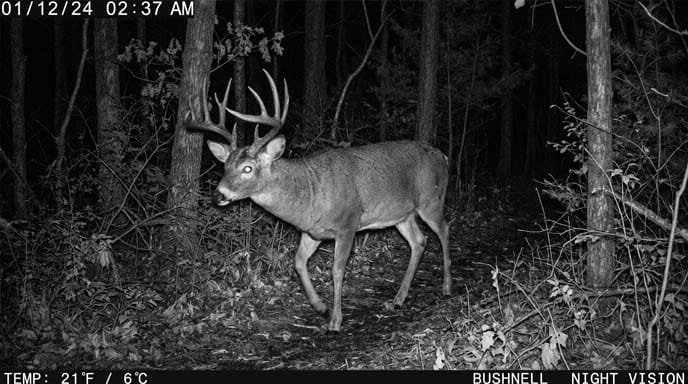
Mature bucks are far more cautious than does or young deer. A doe may investigate a sound and continue feeding if the threat seems minor. A mature buck will often vanish without ever confirming what spooked him — this is why big bucks are rarely seen and often remembered.
Habituation & Learning
Whitetails are remarkably intelligent and have demonstrated the ability to learn, remember, and adapt to hunting pressure. A deer that has been hunted repeatedly will:
- Shift its activity patterns to early morning or deep night
- Avoid areas associated with past danger
- Display heightened caution in familiar places
- Educate younger deer about dangerous areas and times
- Become increasingly difficult to pattern as season progresses
This is why a buck might be visible and patternable in early season but seemingly vanish by mid-season on heavily hunted properties. This is learned behavior, not seasonal relocation.
Curiosity vs. Caution
Whitetails are curious animals, particularly young does and immature bucks. A slight noise or movement will often trigger investigation rather than flight. However, this curiosity is always tempered by caution. A curious deer will approach slowly, frequently pausing to assess the situation.
Mature bucks rarely indulge curiosity if danger is suspected. They make rapid threat assessments and leave.
Seasonal Behavior Patterns: What Drives Whitetail Movement
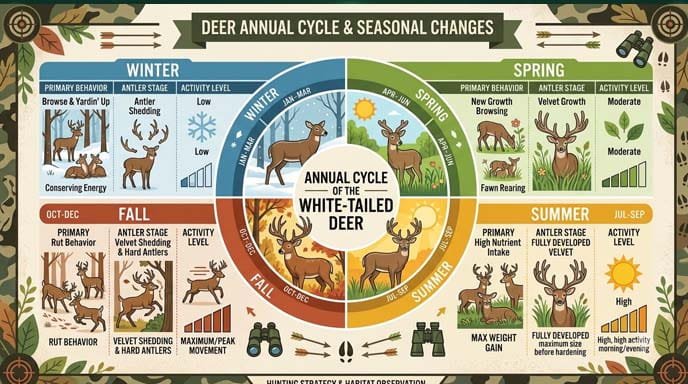
Whitetail behavior is seasonal. Understanding these seasonal patterns is the key to predicting movement and positioning yourself for success.
🌱 Spring (March-May)
Primary behavior: Recovery from rut stress, fawn preparation
Buck activity: Minimal. Bucks are recovering from the rut and are skinny, exhausted, and spending most time feeding. They prioritize food over movement. Antler growth is beginning.
Doe activity: Pregnant does are moving frequently to find quality forage as they prepare to give birth (late May/early June). They’re seeking soft, new vegetation.
Habitat focus: South-facing slopes (warmth), fresh green growth, wet areas where new vegetation is most lush.
Hunting relevance: Spring hunting is closed in most states, but understanding spring movement helps predict summer/fall patterns.
☀️ Summer (June-August)
Primary behavior: Feeding, resting, velvet growth
Buck activity: Bucks are on a feeding/resting cycle. They’re building body mass and growing velvet-covered antlers (soft, still-growing antlers covered in fuzzy skin). Most activity occurs at dawn, midday rest in dense cover, then feeding again at dusk. Bucks maintain tight home ranges in summer.
Doe activity: Does are nursing fawns (born in late May/early June). They’re moving frequently between fawning areas and prime feeding locations. Fawns are hidden and immobile; does spend significant time away from them during the day.
Habitat focus: Green, lush areas with adequate cover. Bucks favor dense thickets and edge habitat. Does prefer areas with escape routes and good visibility.
Hunting relevance: Summer velvet hunting (where legal) shows buck movement patterns. Patterns established in summer are often maintained through fall.
🍂 Fall Pre-Rut (September-Mid-November)
Primary behavior: Antler hardening, bachelor group breakup, rut preparation
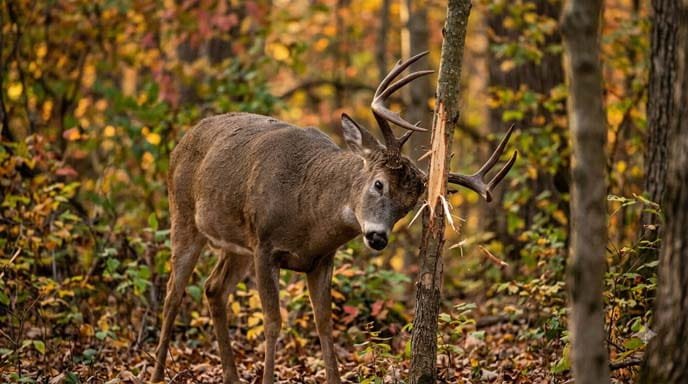
Buck activity: Early September: Velvet shedding, bucks beginning to test dominance within bachelor groups. Mid-September onward: Bachelor groups dissolve, bucks begin establishing territories and rubbing antlers on trees (antler rubs). By late October, testosterone is rising and bucks become aggressive toward other bucks. Movement increases dramatically as bucks search for does and establish pre-rut territories.
Doe activity: Does are moving more frequently. Young bucks (yearlings) are often chased off by dominant bucks. Does begin moving toward traditional rut staging areas.
Habitat focus: Transition zones (edges between feeding and bedding), rub lines, scrape areas, doe bedding areas
Critical hunting opportunity: This is when bucks are most visible and patternable. Pre-rut is often considered the BEST time to hunt because bucks are moving during daylight seeking does, but aren’t yet completely crazy (as they become during peak rut).
❤️ Rut (Mid-November-December, varies by latitude)
Primary behavior: Mating season — dominates all other behaviors
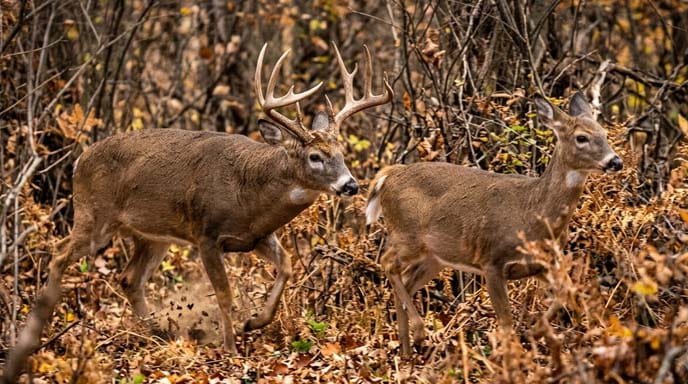
Buck activity: Peak rut (usually 10-20 days in November): Bucks are searching obsessively for does in estrus. They abandon territory, ignore feeding, and move erratically at all hours. A buck in peak rut will often ignore danger and move recklessly. Secondary ruts occur 28 days later as does that didn’t conceive come into estrus again. Some sources describe a tertiary rut in January, though this is typically weaker.
Doe activity: Does in estrus are being pursued relentlessly by bucks. A buck will follow a doe’s scent trail for miles. Does in estrus will sometimes stand for a buck for several hours before moving on.
Habitat focus: Wherever does are bedding and feeding. Rut activity is less habitat-dependent because bucks are moving everywhere.
Hunting relevance: Peak rut (3-4 week window) offers both the highest encounter rates AND the most unpredictable hunting. Bucks in peak rut are less cautious but also less patternable.
❄️ Late Season (January-February)
Primary behavior: Survival, energy conservation
Buck activity: Post-rut bucks are exhausted and depleted. They’ve lost significant body weight and are recovering from the physical and metabolic demands of the rut. Most activity centers on feeding. Bucks are weak and cautious, spending significant time in dense cover. Movement is usually limited to dawn and dusk feeding periods.
Doe activity: Does that successfully bred are pregnant. Activity is minimal; feeding is focused on maintaining body condition.
Habitat focus: Food sources (standing corn, agricultural fields, browse), dense cover for bedding
Hunting relevance: Late-season hunting can be productive if you can predict feeding patterns, but it’s physically demanding (cold, snow) and bucks are in poor condition.
Social Structure & Herd Dynamics
Matriarchal Society
White-tailed deer live in a matriarchal society. The oldest, most experienced doe typically leads a family group (a doe, her yearling offspring from the previous year, and new fawns born that spring). Mature bucks live largely solitary lives, especially during non-rut periods.
Family Groups & Kinship
Doe family groups are cohesive. Mothers teach fawns survival skills, including predator avoidance, preferred feeding areas, and bedding locations. This is why a doe that has survived a hunting season often becomes nearly impossible to hunt — she’s learned where danger occurs and actively teaches younger deer to avoid those areas.
Bachelor Groups
Young bucks (yearlings and 2-year-olds) often form loose bachelor groups during summer and fall. These groups begin breaking apart in mid-September as testosterone rises and competition increases. By October, most bachelor groups have dissolved as bucks establish territories and compete for dominance.
Dominance Hierarchy
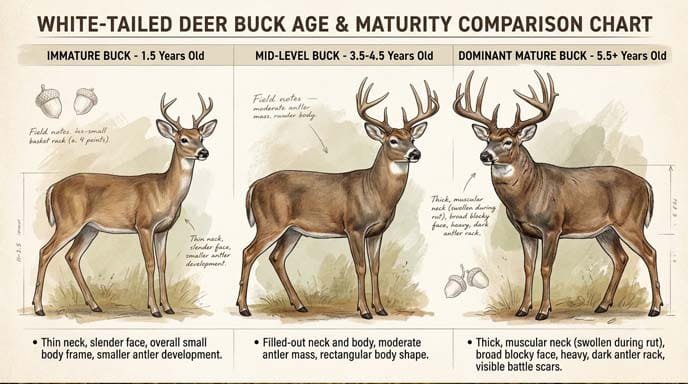
Among bucks, dominance is established through antler size, body mass, and fighting ability. A dominant buck typically has:
- Larger antlers (though not always the largest in the area)
- Larger body mass
- More scars/battle wounds
- Confidence in challenging other bucks
Interestingly, dominance isn’t always about being the biggest. A scrappy, aggressive 3-year-old might dominate a 5-year-old that’s poorly conditioned. However, a truly dominant mature buck can control a territory and exclude younger bucks from breeding opportunities.
Communication: How Whitetails “Talk”
Visual Signals
Tail position: A raised, flagged tail signals alarm and alerts other deer to danger. Tucked tail indicates submission or fear.
Ear position: Pinned back ears indicate aggression; alert ears point toward sounds of interest.
Body posture: A rigid, stiff-legged gait is an aggressive display. Relaxed, fluid movement indicates comfort.
Vocalizations
Whitetails are generally quiet animals, but they do vocalize:
- Snort: An explosive nasal exhalation indicating alarm. Often repeated. This is the classic “alarm snort” that alerts the herd to danger.
- Mew: A soft bleat, often used by does to communicate with fawns or bucks to signal readiness to breed.
- Bawl: A louder, distress call used by fawns when separated from mothers or young deer in distress.
- Grunt: Bucks produce various grunts: tending grunts (following does in heat), social grunts, and aggressive grunts (before or during fights).
- Chuckle: A series of soft vocalizations, usually between a doe and fawn.
- Wheeze: An aggressive sound made by rutting bucks, often accompanied by a lip curl.
Scent Communication (Pheromones)
Whitetails rely heavily on scent communication, especially during the rut:
- Tarsal glands: Inner hock of hind legs. These glands produce a strong-smelling secretion that whitetails rub into scrapes. Each deer has a unique scent profile in their tarsal gland secretion.
- Interdigital glands: Between hoof clefts. Leave scent at bedding and feeding areas; hunters can follow scent trails.
- Preorbital glands: In front of eyes. Used during aggressive displays and rub-urination behavior.
- Metatarsal glands: On outside of hind legs. Function unclear, but active during alarm.
- Rut pheromones: Does in estrus produce pheromones that can be detected by bucks from miles away.
Habitat Preferences & Home Range
Ideal Whitetail Habitat
White-tailed deer thrive in edge habitat — areas where two different habitat types meet. Ideal whitetail habitat includes:
- Diverse forest composition: Mix of hardwoods, softwoods, and brush for bedding and feeding
- Agricultural areas: Crops provide high-quality, concentrated nutrition. Nearby cover allows deer to feed in fields then retreat to safety.
- Brushy edges: Dense cover near open areas. Whitetails use edges as corridors and ambush points.
- Water: Whitetails need reliable water sources, though they obtain much hydration from vegetation.
- Varied topography: Ridge systems, valleys, and slopes create natural cover and travel corridors.
The absolute worst habitat for whitetails is uniform, single-species forest with little edge or understory diversity. The best habitat has maximum edge — agricultural land adjacent to thick timber, or a mix of open areas and dense brush.
Home Range Size
Home range size varies dramatically based on habitat quality, season, and individual deer:
Typical Home Range Sizes:
Does with good habitat: 100-300 acres year-round
Does with poor habitat: 500+ acres
Bucks in non-rut period: 200-400 acres
Bucks during pre-rut: 400-800 acres (expanding territory)
Bucks during peak rut: 1000+ acres (ranging far searching for does)
Urban whitetails: 25-100 acres (habituated, secure in human presence)
Critically, whitetails are generally faithful to their home range. A deer that has survived in an area will return to that area year after year. This is why patterning a specific buck becomes possible — he’s likely using a relatively consistent pattern on familiar territory.
Travel Corridors & Funnels
Whitetails don’t move randomly across the landscape. They follow natural corridors between bedding and feeding areas:
- Ridge lines (natural highway)
- Valley bottoms (often follow water)
- Narrow strips of cover connecting larger habitat patches
- Saddles between ridges (natural pass-throughs)
- Brushy draws that offer cover while allowing movement
Feeding Patterns & Food Preferences
Seasonal Food Preferences
Whitetail diet shifts dramatically by season based on availability and nutritional needs:
Seasonal Diet Breakdown
| Season | Primary Foods | Secondary Foods | Hunting Implication |
|---|---|---|---|
| Spring | New browse, green shoots, clover, fresh vegetation | Buds, catkins, mushrooms | Focus on areas with earliest green-up |
| Summer | Clover, alfalfa, agricultural crops, leafy browse | Grasses, forbs, berries (if available) | Agricultural fields are primary attractions; focus on field edges |
| Fall (Pre-rut) | Hard mast (acorns, hickory nuts, walnuts), browse, agricultural crops | Soft mast (apples, persimmons), mushrooms | Acorn availability can concentrate deer; hard mast areas become hotspots |
| Late Season | Browse, remaining agricultural crops (corn, beans), evergreen browse | Dried fruits, lichen, bark | Food is survival; hunting near food sources is most productive |
Daily Feeding Patterns
Whitetails are crepuscular, meaning they’re most active at dawn and dusk. However, feeding patterns vary by season:
- Summer: Usually 2 feeding periods: dawn (0.5-2 hours after sunrise) and dusk (1-3 hours before sunset). Midday rest in heavy cover.
- Early fall: Extended dawn feeding (can last 3-4 hours), extended dusk feeding. Midday feeding possible if acorns are dropping heavily.
- Pre-rut/Rut: Feeding is less predictable as rut behavior dominates. Bucks may move at any time.
- Late season: More consistent feeding patterns; dawn and dusk feeds are critical for calorie intake.
Bedding Behavior & Thermoregulation
Bedding Areas
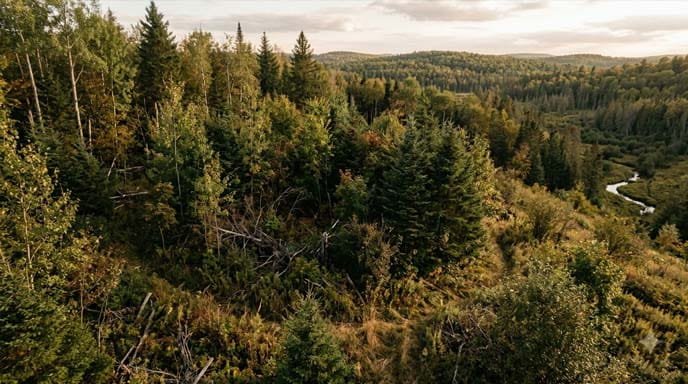
Whitetails spend significant time bedded (resting). A bedded deer is vulnerable, so bedding areas are chosen with security in mind:
- High-security beds: Dense brush, thickets, or areas with limited access. These are preferred, especially for mature bucks.
- Elevated positions: Ridges or knolls that provide vantage points to detect approaching danger.
- Near escape cover: Beds are positioned with nearby brush or timber for quick escape.
- Downwind positions: Whitetails often bed in positions where they can scent-check danger approaching from upwind.
Rumination & Digestion
Like all ruminants, whitetails are ruminators — they eat quickly at feeding areas, then retire to secure locations to ruminate (regurgitate food and re-chew it for complete digestion). A whitetail will often:
- Feed intensely for 0.5-2 hours at dawn
- Move to a secure bedding area
- Ruminate (regurgitate and re-chew) for 1-2 hours
- Rest and digest
- Repeat at dusk
Thermoregulation
Whitetails adjust their bed selection based on temperature:
- Summer: Beds in open, breezy areas to stay cool. South-facing ridges where air moves freely.
- Winter: Beds in dense cover to retain heat. Conifer thickets are preferred; dense evergreen cover blocks wind and radiates retained warmth.
Rubs, Scrapes, and Buck Sign
Antler Rubs
A rub is made when a buck rubs his antlers against a small tree or sapling, removing bark and velvet. Rubs serve multiple purposes:
- Velvet removal: As velvet sheds (August-September), bucks make rubs to accelerate the process and harden antlers.
- Territorial marking: Rubs are territorial statements. A buck’s velvet glands and rubs communicate to other bucks: “This is my territory.”
- Scent marking: Bucks work their preorbital glands on rubs, leaving scent that communicates their presence and status.
- Aggression expression: Making rubs is a way bucks express dominance and redirect aggressive energy.
Rub characteristics:
- Usually on small trees (1-3 inches diameter) — saplings are preferred
- Often in a line (rub line) — bucks tend to follow the same route, rubbing trees along the way
- Rubbed bark exposes white/light wood interior
- Rubs typically occur in mid-September through November, peaking in late September/early October
Scrapes
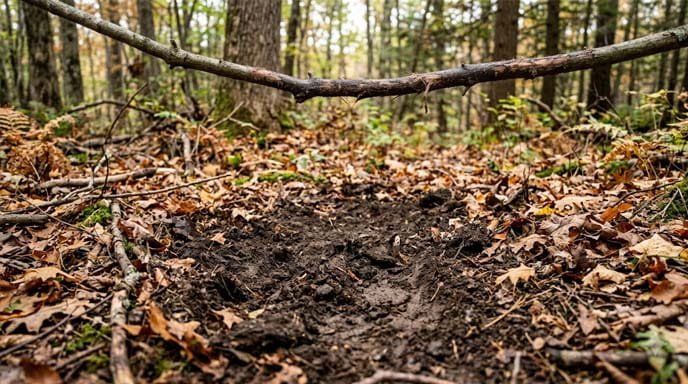
A scrape is a pawed area (usually 2-4 feet in diameter) where a buck has scraped away leaves and forest floor, exposing bare ground. Above the scrape, there’s often an “overhead branch” that the buck rubs with his face and antlers. Scrapes are communication centers:
- Scent communication: A buck urinates in the scrape, leaving his unique scent profile (via tarsal glands). Other deer (especially does) visit the scrape to read the buck’s scent — his age, health, dominance status, and reproductive status.
- Information gathering: Does visit scrapes too, leaving their scent to inform bucks of their estrous status.
- Territorial marking: Active scrapes indicate a buck’s territory and movement patterns.
- Buck identification: Multiple bucks may visit the same scrape, making it a central meeting point.
Scrape characteristics:
- Usually located in transition zones between bedding and feeding areas
- Often near does’ preferred areas — scrapes are about communication with does
- Peak scrape activity: Late October through November (pre-rut and rut)
- Active scrapes may be revisited multiple times daily
- A scrape with fresh disturbance indicates recent visitation
Applying This Knowledge: Practical Hunting Strategies
Wind Management (Scent Control)
Understanding that scent is the primary threat detection method means wind management is your #1 priority:
- Always hunt downwind of where you expect deer to appear
- Position your stand so prevailing wind carries your scent away from deer approach routes
- Monitor wind direction constantly; a shifting wind can educate a deer to your presence
- Thermals (wind shifts as temperatures change throughout the day) are a consideration in certain terrain
Positioning & Stand Location
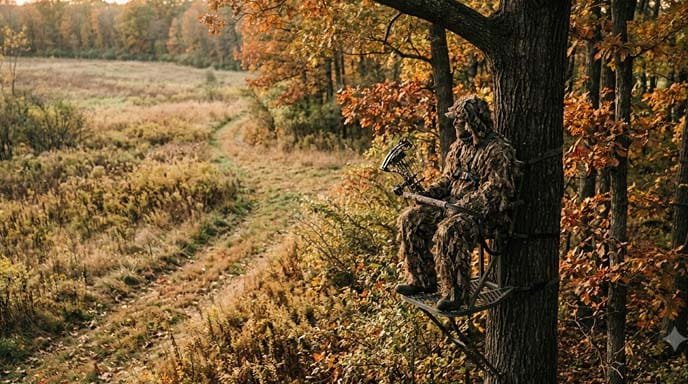
Position is about:
- Ambushing deer on known travel corridors
- Being downwind and between bedding and feeding areas
- Positioning on elevated terrain to maximize scent dispersal and visual range
- Using terrain features (ridges, valleys) to funnel deer to your position
Movement & Stillness
A whitetail’s exceptional motion detection means:
- Remaining absolutely still during hunting hours is critical
- Even small movements (arm movements, head turns) can trigger detection
- Use cover and camouflage to break up your human outline
- Face mask, gloves, and full camo are essential
Sound Discipline
While whitetails are somewhat tolerant of natural sounds, unnatural sounds are immediately suspicious:
- Moving slowly and deliberately is quieter than moving quickly and awkwardly
- Avoid loud noises or mechanical sounds
- If you’re discovered by sound, freezing immediately is often the best response
Hunting Seasons & Timing
Optimal hunting windows by season:
- Early season (Sept): Hunt summer patterns; deer still following established feeding routes
- Pre-rut (Oct-early Nov): Hunt travel corridors and bedding areas; bucks seeking does
- Peak rut (mid-Nov onwards): Hunt doe concentration areas; bucks will find does
- Late season: Hunt food sources; deer are survival-focused
Common Myths vs. Reality
❌ MYTH: Whitetails are colorblind and see only in black and white
✅ REALITY: Whitetails see in color, primarily in the blue-yellow spectrum. They have poor red vision, which is why blaze orange appears dark or yellow to them (but is highly visible to humans). They CAN see color; they just have different color sensitivity than humans.
❌ MYTH: Whitetails panic and run blindly from danger
✅ REALITY: Whitetails make rapid threat assessments and respond deliberately. A mature buck often vanishes silently without ever confirming what spooked him. Panic is not a characteristic of whitetail behavior; deliberate threat response is.
❌ MYTH: The biggest buck is always the most dominant
✅ REALITY: While larger bucks often dominate, aggression, confidence, and fighting ability matter. A scrappy 3-year-old might dominate a poorly-conditioned 5-year-old. Multiple factors determine dominance hierarchy.
❌ MYTH: Scent control products completely eliminate human odor
✅ REALITY: No product completely eliminates human odor. Scent control can reduce odor and mask some compounds, but wind management is far more important than any scent control product. If you’re hunting into the wind, you’ll be detected eventually. If wind is right, a well-scented hunter might not be detected even without scent control.
❌ MYTH: Does are less wary than bucks
✅ REALITY: Mature does are often MORE wary than bucks. A mature doe has learned where danger occurs and educates younger deer accordingly. Doe family groups often completely avoid hunted areas by mid-season.
Frequently Asked Questions About Whitetail Behavior
Conclusion: The Educated Hunter Wins
White-tailed deer are not magical creatures or impossible puzzles. They’re intelligent, cautious animals with predictable sensory abilities, seasonal behavior patterns, and learnable movement habits. Understanding these characteristics is the foundation of becoming a consistently successful hunter.
The whitetail’s primary defense system is built on three pillars: scent detection, motion detection, and learned avoidance. A successful hunter defeats these defenses through:
- Wind management (defeating scent detection)
- Stillness and camouflage (defeating motion detection)
- Understanding seasonal patterns and home range (positioning yourself correctly)
- Patience and respect for the animal (allowing the deer to make the mistake)
The deer you encounter may be cautious, intelligent, and remarkably aware. But they’re also bound by their senses, seasonal instincts, and home range fidelity. Learn these patterns, respect the animal’s abilities, hunt ethically, and you’ll find consistent success in the field.
Good hunting, and remember: every whitetail represents an opportunity to learn something new about their behavior. The best hunters are lifelong students of the animals they pursue.
About This Guide
This guide is based on field research, published wildlife biology studies, and 30+ years of hunting and observing white-tailed deer. While this information has been thoroughly fact-checked, individual deer behavior can vary by region, season, and local conditions. Always hunt legally, ethically, and safely. Respect your local game laws and bag limits.

Leave a Reply